Minecraft Iron Farm Not Working? Fix Java & Bedrock Golem Spawns
Iron
By GamerCubic Editorial Team · Last checked: November 12, 2026 · Version scope: Java 26.3 and Bedrock 26.63
Quick answer: A broken iron farm is usually failing in one of three places: the villagers are not eligible to create a golem, the golem is spawning somewhere other than the intended platform, or the collection system is losing the drops. First confirm that the tutorial was built for your edition. Then prove each system separately instead of replacing random blocks.
Start with these four checks:
- Confirm the edition: a compact Java zombie-panic farm does not satisfy Bedrock village rules.
- Search for an escaped golem: inspect roofs, caves, ledges and the ground below the villagers.
- Watch the villagers: Java villagers must refresh their sleep history; most Bedrock villagers must work.
- Test the output: throw an ordinary item onto every hopper before blaming golem spawning.
Evidence note: GamerCubic checked current documented mechanics and the official Java 26.3 and Bedrock 26.63 release status. We did not reproduce every community iron-farm design in-game, so the images below are explanatory illustrations rather than proof that one exact blueprint works. Back up an important world before rebuilding.
Run This Iron Farm Isolation Test First
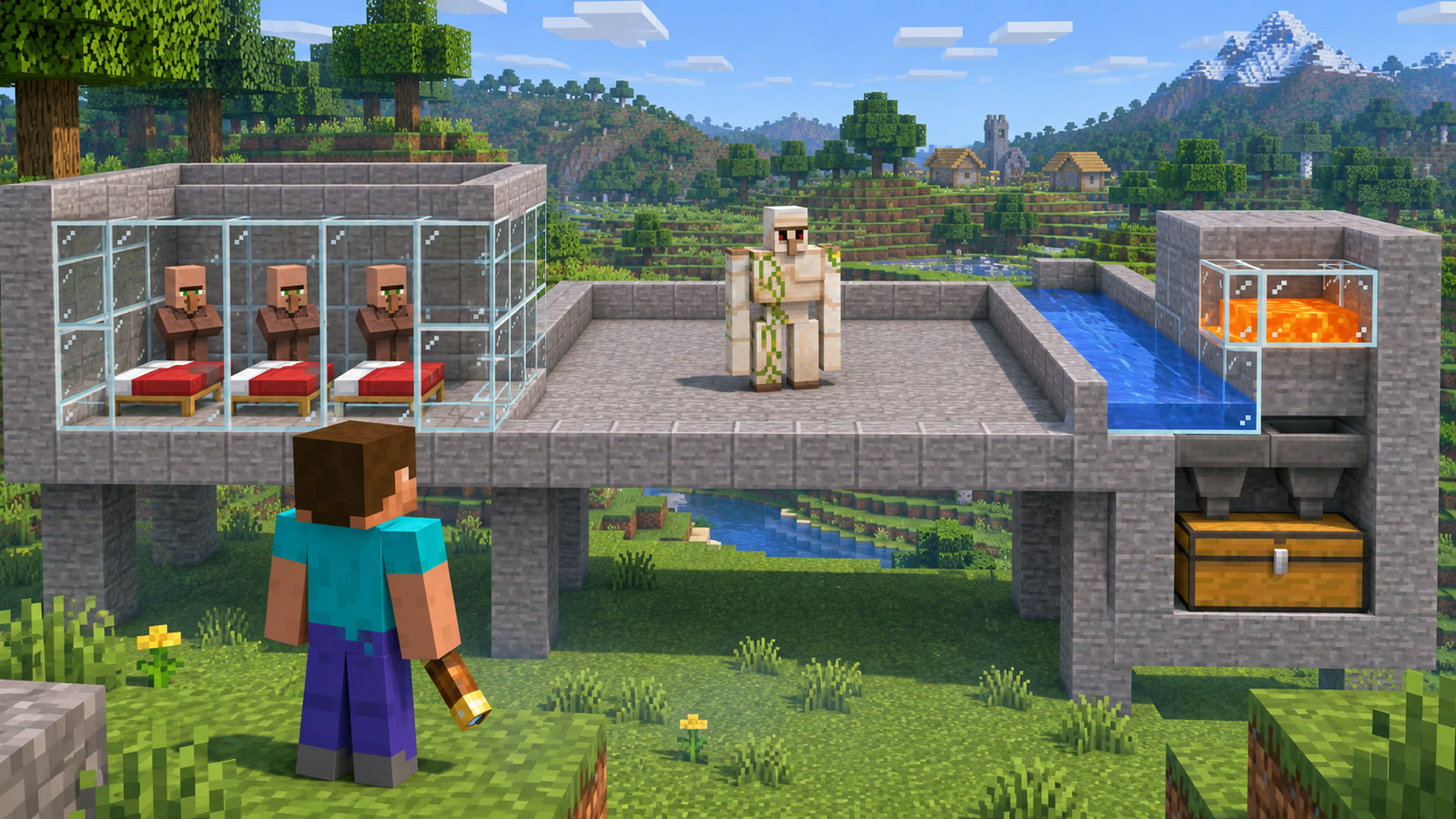
This test turns a vague “farm not working” problem into an observable failure. Keep the farm loaded, change only one variable at a time and record what happens.
| Test | Pass | If it fails |
|---|---|---|
| Stand at the farm through one day-and-night cycle | Java villagers briefly sleep; Bedrock villagers visit workstations | Repair beds, line of sight or workstation access |
| Search every nearby solid surface | No golem exists outside the collection route | Remove the golem and spawn-proof that surface |
| Temporarily expose a large, clear solid platform | A golem appears on the test platform | Villager eligibility or village-center alignment is still wrong |
| Drop an item onto each hopper | The item reaches the output chest | Correct hopper direction, redstone power or container space |
Do not rebuild the kill chamber before running these tests. If a golem appears on a temporary platform, the villager system is alive and the original platform is the problem. If items pass through the hoppers but no golem appears anywhere, focus on villager and edition requirements.
Java vs Bedrock Iron Farm Requirements

| Requirement | Java Edition | Bedrock Edition |
|---|---|---|
| Villagers | 3 eligible villagers for panic; 5 for gossip-based summoning | At least 10 villagers |
| Beds | Participating villagers must have slept within the last 20 minutes | At least 20 beds; every villager linked to a bed |
| Workstations | Not required for current golem summoning | At least 75% of villagers worked during the previous day |
| Threat mob | Common in panic designs | Not the core spawning requirement |
| Nearby golem limit | Eligible villagers must not have detected a golem recently | Fewer than one natural or village-spawned golem per 10 villagers |
| Active area | Eligible villagers and valid nearby spawn cells | Village within simulation distance; attempts around village center |
The key Java timers are specific: villagers must have slept within 20 minutes, must not have detected an iron golem within 16 blocks during the previous 30 seconds, and must not have been near a recent successful summoning. The participating villagers must also remain close enough to one another. These mechanics are documented in the Iron Golem farming reference.
Bedrock instead builds a functioning village. It needs 10 villagers, 20 beds, full bed linking and a 75% work threshold. A farm copied from the wrong edition can look complete while failing every relevant spawning condition.
Java Test: Prove the Villagers Are Eligible

- Block the zombie completely. At night, every participating villager should be able to enter a bed, even if only briefly.
- Restore the scare cycle. Confirm all three villagers can see the hostile mob from their eye level and visibly panic.
- Keep the group together. A separated villager can leave the three-villager panic group incomplete.
- Clear nearby golems and wait at least 30 seconds. This removes the recent-detection and recent-summoning cooldown as a false lead.
- Expose a clean spawn surface. If no golem appears after the sleep and panic states are proven, inspect the platform rather than adding workstations.
Workstations do not make current Java villagers eligible to summon golems. Older tutorials may include them for positioning or trading, but adding job-site blocks will not repair a failed recent-sleep or panic condition.
Bedrock Test: Prove the Village Is Valid
Count the actual villagers, beds and job-site blocks. Do not estimate from memory. Babies and nitwits cannot work, so too many non-working villagers can prevent the village from reaching its 75% threshold even when the total population is high enough.
- Confirm at least 10 villagers remain inside the farm.
- Confirm at least 20 beds exist and each villager has a bed link.
- During work time, watch villagers reach their own workstations.
- Break and replace one suspect workstation at a time; use the claim particles to identify the villager that links to it.
- Allow a complete working period before judging the repair.
Replacing every workstation simultaneously creates a new linking puzzle and hides the original fault. Mojang’s confirmed parity report MCPE-186580 records that Bedrock iron-farm spawning depends on villagers being able to work, unlike current Java summoning.
Fix the Golem Spawn Platform

A valid-looking platform can still lose to another surface. Search from the villagers outward: chamber roof, walls, stairs, surrounding ground, shallow caves and spaces below the farm. One hidden golem can suppress more spawning while making the villager chamber appear broken.
For Bedrock, spawn attempts occur in a 17×13×17 volume around the village center: eight blocks horizontally and six vertically from that point. The game checks random positions and needs a solid block below with a clear 2×4×2 space for the golem. It can choose the highest valid surface at a horizontal location, which is why roofs and ledges matter.
Use spawn-proofing as a diagnosis, not decoration. Start with the closest competing blocks and test again. If the test platform works, reproduce its solid support and clearance in the intended channel before removing it.
Java Fix: Repair Zombie Line of Sight
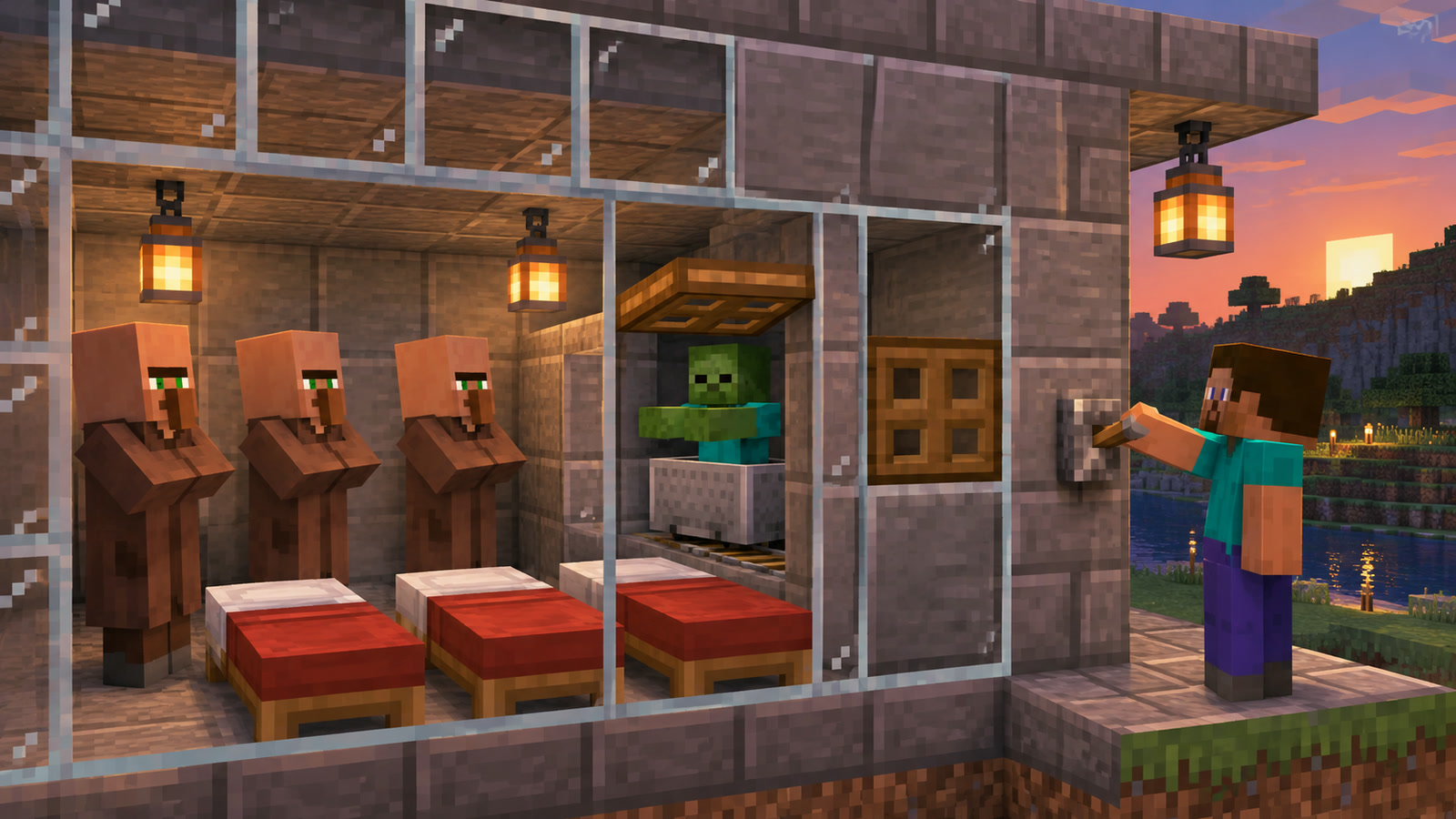
Seeing a zombie and sleeping are opposing states, so a good Java design controls both. A misplaced trapdoor, minecart, wall or one-block height difference can hide the zombie from one villager. Permanent eye contact can create the opposite failure by preventing the villagers from refreshing their sleep history.
At night, close the sight line until all villagers attempt to sleep. Reopen it and confirm all three panic. Protect the zombie from sunlight, despawning and accidental golem attacks; a name tag is the clearest persistence method. On Peaceful difficulty, an ordinary zombie disappears, so a zombie-based panic design cannot keep operating.
Bedrock Fix: Rebuild a Stable Village Center

The Bedrock village center begins from a linked bed pillow and can shift as villagers link or unlink from points of interest. A nearby breeder, trading hall, house bed or extra workstation can expand or merge the village and move spawn attempts away from the platform.
For diagnosis, remove nonessential beds, bells and workstations around the farm, then keep the required beds tightly clustered. Test while standing close enough for the entire village to remain inside simulation distance. If it works near the farm but stops from the AFK platform, the AFK position is outside the active volume.
Bedrock allows fewer than one naturally generated or village-spawned golem per 10 villagers. With 10 villagers, a trapped golem can block the next one. Do not add villagers blindly: every new villager also needs a valid bed link, and the village must still satisfy the work percentage.
Golems Spawn but Iron Never Reaches the Chest

Watch one complete cycle. The golem must leave the spawn platform, clear every corner, die without destroying its drops, and place the ingots and poppies within hopper pickup range. A sign, wall, gate or water-source gap can stop the golem before the kill chamber.
Then test the storage path without waiting for another spawn. Throw a disposable item onto each hopper. Confirm the hopper points toward the next container, is not powered by nearby redstone and has free slots. Check the final chest and every intermediate hopper. If the test item arrives, the collection path works and the fault is earlier in the cycle.
Iron Farm Symptoms and the Most Useful Next Test
| What you observe | Likely cause | Next test |
|---|---|---|
| Java villagers never sleep | Permanent zombie visibility or blocked beds | Hide the zombie for one night |
| Java villagers sleep but never panic | Blocked sight line or missing hostile mob | Check each villager from eye level |
| Bedrock villagers show link problems | Missing, unreachable or cross-linked POI blocks | Relink one bed or workstation at a time |
| Golems appear on the ground | Competing valid surface or shifted center | Remove the golem and test a controlled platform |
| Farm works only at close range | Simulation-distance problem | Move the AFK point closer |
| Farm stopped after adding a breeder | Merged Bedrock village | Remove new POI blocks and retest |
| Golems die but output stays empty | Locked, misdirected or full collection path | Run the disposable-item hopper test |
How to Tell Whether the Tutorial Is the Problem
Check the tutorial’s edition, game version and update date before altering the build. Warning signs include Java villagers and a zombie presented as a Bedrock farm, Bedrock workstations treated as optional, or a platform centered on a location that no longer matches the active bed cluster.
Server software, add-ons, commands and custom simulation settings can also change chunk activity or mob behavior. Reproduce the design in a backup vanilla world with the same edition and release if possible. If the clean copy works, the original world has an environmental conflict rather than a blueprint error.
Frequently Asked Questions
Why did my iron farm suddenly stop?
A villager may have lost a bed or workstation, Java villagers may have missed sleep, a golem may be trapped nearby, or new Bedrock village blocks may have shifted the spawning area.
How many villagers does an iron farm need?
A common Java panic farm uses three eligible villagers. Bedrock needs at least 10 villagers and 20 beds, with every villager linked to a bed and at least 75% having worked.
Do Java iron farms need workstations?
No, not for current golem-summoning eligibility. A tutorial may still use workstations for villager positioning, professions or compatibility with an older design.
How long should a Bedrock golem take to spawn?
When every condition is met, Bedrock averages one spawn attempt about every 35 seconds, but an attempt can fail if no checked position is valid. Treat that as an average, not a timer.
Why are golems spawning outside the farm?
The game found another valid surface inside its search area. Remove the golem, spawn-proof that surface and verify that the intended platform is aligned with the villagers or Bedrock village center.
Can an iron farm work on Peaceful?
A Bedrock village design does not require a hostile scare mob. A Java panic farm that relies on a zombie fails when Peaceful removes the zombie, so it needs a different summoning design.
Continue Exploring GamerCubic
Check the latest Minecraft version guide before copying an older blueprint, browse Redstone Guides, or use GamerCubic’s Minecraft tools and generators. If a test command fails, the Minecraft /give command troubleshooting guide covers edition and syntax mismatches.
Final Verdict
Do not diagnose an iron farm as one machine. Prove the villagers are eligible, prove the game has a valid spawn area, then prove the drops can reach storage. Java repairs usually revolve around recent sleep, a complete panic group, controlled zombie visibility and nearby golems. Bedrock repairs revolve around a valid working village, stable POI links, the village center and simulation distance.
If you change one variable at a time, the first failed observation identifies the broken system. That is faster—and safer—than rebuilding a functioning villager chamber because the real golem is standing in a cave underneath it.
Continue Exploring

What Do Chickens Eat in Minecraft? Food, Breeding & Farm Guide
The verified seeds that attract and breed chickens, plus efficient farm and troubleshooting advice.

Minecraft Cold Sulfur Cube Guide: Blue Ice & Frosted-Ice Trails (26.4)
A verified guide to the Cold Sulfur Cube, Blue Ice absorption and Frosted-Ice water trails in Minecraft 26.4 Snapshot 6.
Minecraft Summon Command Examples
Practical Minecraft summon command examples for Java: summon mobs, choose coordinates, fix common errors, and understand Java versus Bedrock limits.